


Science Seminar: “Questionnaire Design for Doctoral Thesis”
On the morning of September 13, 2026, at the Head Office No. 778 Nguyen Kiem, University of Finance and Marketing, the Institute of International Political Economy held a Scientific Seminar with the theme “Designing a questionnaire for doctoral thesis topics”. The scientific meeting was held in the form of direct and online (Offline + Online) to create a quality academic forum for lecturers and doctoral students.
1. Time, place and composition of delegates
Time: Starts at 08:30, Sunday morning, September 13, 2026.
Venue: Thematic Meeting Room, Head Office No. 778 Nguyen Kiem, Duc Nhuan Ward, Ho Chi Minh City and online platform.
Chairman: Dr. Lai Van Nam - Director of the Institute of International Political Economy.
Rapporteur: Dr. Nguyen Quang Giai
Secretary: Trinh Le Minh Ngoc.
Participants: Lecturers and researchers of the Institute, as well as PhD students and graduate students.
2. Purpose and meaning of the seminar
Speaking at the opening of the program, the representative of the Institute's leadership emphasised that the purpose of the seminar is to create a practical scientific forum for academic exchange on primary data collection tool design techniques.
In addition, Dr. Lai Van Nam, Director and Chairman of the seminar, also stated that the requirement of the meeting is to help PhD students improve their ability to design questionnaires in a scientific way. This is to ensure scientific honesty in the research process and increase the possibility of international publication for authors.
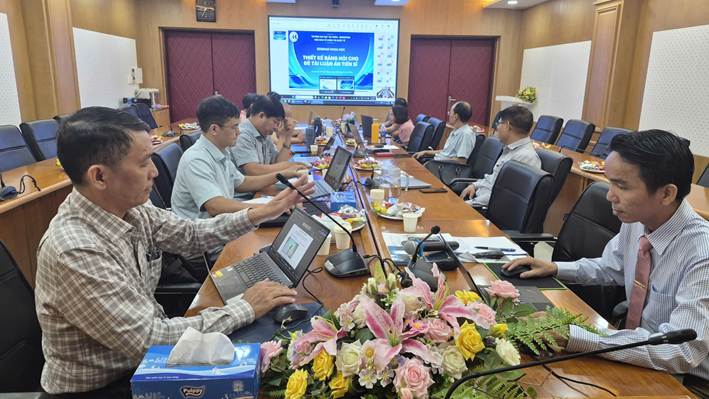
Dr. Lai Van Nam, Director of the Institute of International Political Economy, delivered the opening speech
3. Thematic report “Questionnaire design for doctoral thesis topics”
At the meeting, Dr. Nguyen Quang Giai presented a detailed report with 5 key contents as follows:
Questionnaire Design Basis: Clarify the close logical connection between the problem, objectives, and research questions and the development of specific survey statements in the thesis.
Define concepts and variables: Detailed instructions for defining concepts, research variables, and the content to be measured so they align closely with the theoretical model.
Conceptual Manipulation and Scale Construction: Give practical illustrative examples of how to transition from an abstract concept to a quantifiable scale.
Questionnaire structure design: An in-depth discussion of the process of building a standard questionnaire and how to present a scientific, well-reasoned questionnaire structure.
Testing and finalisation: Presenting testing techniques and finalising the questionnaire before conducting formal data collection for the survey.
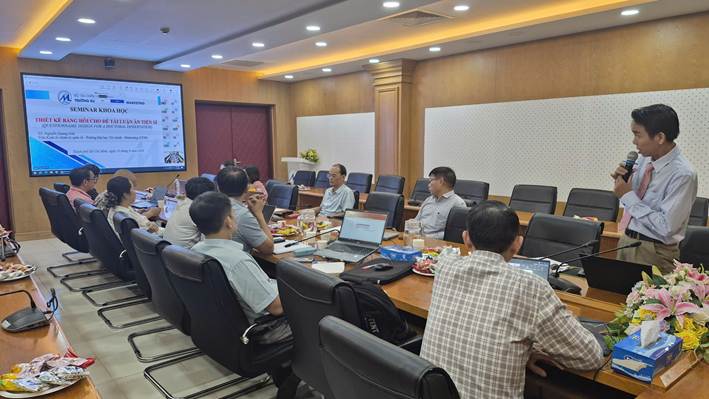
Dr. Nguyen Quang Giai presented the report
4. Atmosphere of exchange, academic discussion and solution-oriented
During the discussion session, many opinions from PhD students majoring in Economic Management received dedicated advice from experts. Specifically:
Regarding conceptualisation manipulation, answering the question of Trieu Thanh Son, Dr. Nguyen Quang Giai said that the concept cannot be set by itself, but must start from the research overview, theoretical basis and legal documents (legalisation). Based on previous and legal research, the researcher builds the concept, thereby turning it into indicators and detailing it into a question to collect information to answer the core problem.
Regarding the role of qualitative data in quantitative models, answering the question of Le Van Phong, Dr. Nguyen Quang Giai affirmed that qualitative helps explain the why, what and how. Qualitative data (through in-depth interviews and observations) when integrated with quantitative testing models will help research theses harmoniously combine the authenticity of empirical data and the basis of practical arguments, thereby making scientific conclusions more weighty and convincing.
Regarding the standard concept criteria and scale development, answering the question of Phuc Doan, Dr. Nguyen Quang Giai instructed to extract all relevant studies with the reliability of international publication of ISI and Scopus standards and the legal basis of the State, compare the local actual context to build measurement concepts and indicators.
Regarding the inheritance or construction of a new scale, Assoc. Prof. Dr. Tran Van Hung advised PhD students not to necessarily pressure to find a completely new (novelty) due to limited time. The inheritance of good models and scales from abroad, and their verification in the practical context in Vietnam (where no one has done so), to strengthen theory and policy proposals has been a valuable scientific contribution.
Regarding the development of the theoretical framework, Dr. Nguyen Duc Hai emphasised the importance of research design and recommended that the researchers build a theoretical framework as the backbone for the entire project. The structure of the framework table needs to have 3 pillars: (1) Scale; (2) Related studies as a basis for qualitative comparison; (3) Inheritance and development content. When applying the scale inherited from abroad, the survey questions need to be refined in accordance with the fluctuations of the current socio-economic context.
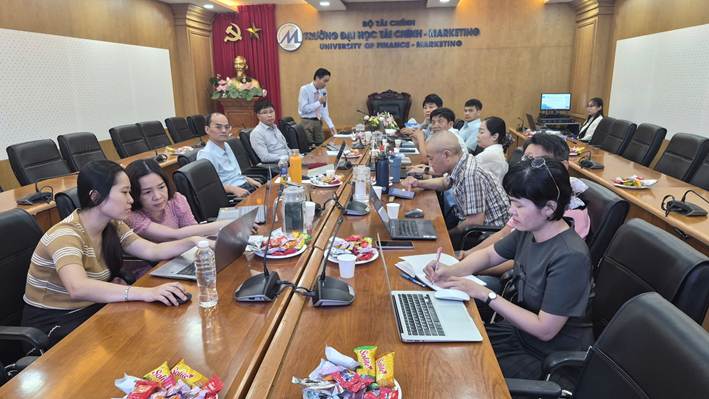
PhD students exchanged and discussed at the Seminar
5. Conclusion
In the end, the representative of the Institute's leaders acknowledged the highly professional comments from the Rapporteur and the active critical participation of the entire hall. The seminar took place seriously and met high academic standards.
By Do Ly Hoai Tan